Whenever I hear someone say they hate to exercise, what I hear is, “I don’t like to move.” Most of us move throughout the day without thinking too much about it. We sit, stand, reach, turn, go up and down stairs without a second thought. But what happens when the ability to move suddenly gets revoked? In truth, we are all only one diagnosis or misstep away from realizing what a blessing it is to simply be able to move at all.
The stories that follow are about resilience and gratitude: movement less as a comeback, more as a gift.
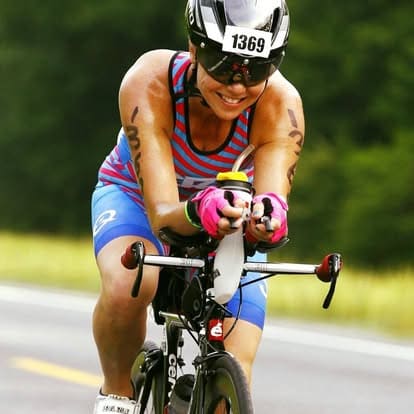
Photos courtesy of Angela CamposFor years, Angela Campos, RN measured herself by movement. As a teenager she swam at the YMCA and dreamed of finishing a full Ironman: 140.6 miles of swim, bike, and run. She did not chase that dream until she was an adult with a nursing career and a family. Then she finished two of them, Mont Tremblant in 2015 and Lake Placid in 2018, with five marathons along the way.
What she did not understand was that her body had been sending signals for a decade.
She tripped more than she should have. Her handwriting got worse. She woke up stiff. She had an excuse for all of it.
When she mentioned the tripping to a doctor, the suggestion was to try different shoes. In 2019, a hamstring injury forced her to stop running. Stopping revealed what training had been masking: real weakness on her right side. In 2021she was diagnosed with degenerative disc disease.
She had come dangerously close to paralysis. Four neurosurgeons reviewed her MRI before they met her and assumed she was already in a wheelchair. She was one hard bump to the head away from becoming quadriplegic. Cervical spine surgery stopped the damage from getting worse, but it could not undo it.
The injury to her spinal cord is permanent.
Photos courtesy of Angela CamposAs a nurse with 25 years of experience, she could read her own chart. That knowledge was both a gift and one of the most sobering experiences of her life. The past year brought a knee replacement and a second spine surgery. She walks with a limp now and sometimes uses a cane so she can move faster and with more confidence.
She does not think of herself as someone who can’t. She just does it differently. This summer, a few months after surgery, she was walking about 28 minutes a mile. A few weeks later, she walked four miles on a trail with her dog, each mile faster than the last, and jogged a few steps at the end.
She came home and wrote, “Today, I ran!!!” That is what gratitude for movement looks like to her now. Not the finish lines she used to cross, but the next step, and the one after that.
What did movement mean to you before your injuries?
It was my identity. For a long time, that identity lived in motion, and in the writing that went with it. My blog is called Marathons & Motivation.
When I couldn’t run anymore, I thought that story was finished, so I stopped sharing anything personal for seven years.
Photos courtesy of Angela CamposWhat was the hardest part of recovery?
Not the surgeries. It was realizing how many signs I’d explained away, and how long it took for someone to take them seriously. As a nurse, I tell patients to trust their bodies. I didn’t take my own advice.
What do people most misunderstand about your diagnosis?
People hear “degenerative disc disease” and think of back pain.
Mine is in my neck, and it damaged my spinal cord. Surgery kept it from getting worse, but it didn’t reverse the damage. That’s why I limp, and why it isn’t something that will simply heal. Explaining that over and over is hard, so I’m grateful for the chance to say it clearly once.
Photos courtesy of Angela CamposWhat does your movement look like today?
Walking and indoor cycling on a structured training plan, the same way I trained for triathlons.
I’m working toward walking a half marathon this December. Swimming will have to wait until my surgeon clears me.
What’s a small win you’re proud of?
Taking seven minutes off my mile in a matter of weeks. Nobody else would notice that number, but I do and it fuels my motivation.
How do you handle comments about the way you move?
People say things. Someone once asked me how I play tennis “with one leg.” Others have asked whether I did this to myself by running all those marathons.
Being active didn’t cause this. The first symptoms showed up after the birth of my daughter. Both questions are hard to hear. The frustration has never been what I can’t do.
It’s other people deciding what I can do.
What would you tell a woman just starting her own recovery?
If you’re in a recovery room somewhere wondering whether your active life is over, it isn’t. It may look different. Different still counts.
Angela Cardamone Campos, is a registered nurse, two-time Ironman triathlon finisher, and the creator of Marathons and Motivation. You can follow her at @MarathonsandMotivation on Instagram and Facebook
For most of her life, movement was who Tara Benoit was.
She was in sports by age three and a competitive athlete by nine. At sixteen, her father brought her into the YMCA weight room and she started lifting. She studied movement science and exercise physiology in college, and by thirty she was a CEO. She spent years on the fitness and bodybuilding stage.
What she excelled at most was doing hard things. Strength was her identity. It is no surprise that she then had two strong, active boys, now ten and twelve. In May 2023, at forty-six, just six months before she was set to compete on a national stage, she sat in bed with what felt like a lightning bolt in her chest.
A few days later came tingling down her left arm and a squeezing in her chest, neck, and jaw. The first ER said her tests looked fine and suggested anxiety. It took six days, two ambulance rides, and two emergency rooms to get the real answer: SCAD, a spontaneous coronary artery dissection. An artery in her heart had torn.
It is a rare, and often misdiagnosed, heart attack in women under fifty. The head cardiologist, with forty years of experience, told her she was about the tenth case he had seen, and that he had never had a patient as fit, or as young.
Then came the stapled pages titled “Things You Can Not Do.” No weightlifting. No HIIT. No hot yoga.
A lifting limit that meant she might not be able to pick up her two little boys. When she asked how long, the answer was, “Not ever.” Coming home was harder than the hospital. She woke in a panic, sure it was happening again, and took her blood pressure three times before her sons were even awake. Cardiac rehab center after cardiac rehab center said they did not know how to work with someone like her.
Then she found the Women’s Heart Health Program and SCAD clinic at Mass General, and Dr. Sarah Tsiaras—a cardiologist and an athlete who looked at her like a person, not a chart. With that team guiding her, she started to move again. Slowly.
Differently. Gratefully. Her movement today looks nothing like it used to, and she loves it more. She is not the woman she was before.
She is the woman she had to become.
Photos by Tara Benoit.What did movement mean to you before your heart attack?
It was my identity and my armor. I lifted, I competed, I pushed my body to the extreme in every area of my life from career to my sports and family. Being strong was how I felt safe in my body. Looking back, a lot of that movement was about proving something.
My body had carried invisible battles long before SCAD, and training was how I kept them quiet.
What was the hardest part of recovery?
Trusting my body again. After SCAD, every twinge felt like a threat. I would lie awake with my hand on my chest, waiting for the next one. The tear in my artery had to heal on its own, with no surgery.
My trust in my body needed its own rehab, and that took longer than the artery did.
How did you learn to trust your body again?
One small choice at a time. A walk around the block. One full breath. One yoga class where I stayed on my mat and let that count.
Slowly I understood something that changed everything: it wasn’t my body that betrayed me. It was my detachment from it. Every gentle movement became a way of coming back into a relationship with my body instead of fighting it.
Photos by Tara Benoit.What was it like accepting a new version of yourself?
Grief came first. I grieved the woman on stage, the heavy lifts, the body I thought I could count on.
The one that had control in everything I did. Then I stopped trying to get back to her. That shift became the M.O.V.E. Method, the framework I share in my memoir, Torn Heart.
Healing was never about going back to who I was. It was about moving forward to who I was always meant to become.
What does your movement look like today?
Yoga, including hot yoga on my own terms: my mat by the cool door, a fan beside me, and permission to rest. Strength training within the limits my care team and I have set. Long walks outside.
And breathwork on the days my body asks for stillness, because stillness is movement too. Movement used to be something I had to earn. Now it is medicine.
What’s a small win you’re proud of?
Walking back into a hot yoga room, the room I was told I would never set foot in again. I put my mat back at the front near the fire and stayed.
Nobody else in that room knew what it meant. I did. And walking the Boston American Heart Association Heart Walk with my husband and boys, all of us in matching SCAD shirts.
Photos by Tara Benoit.What would you tell a woman just starting her own recovery?
Listen to the whisper. Your body knows before your mind does.
Keep saying “this doesn’t feel right” until someone listens. And when you are ready to move again, start smaller than your ego wants and celebrate every step. You are not behind. You are becoming.
Tara Benoit is a former corporate CEO, functional medicine wellness nutrition practitioner, former elite athlete, SCAD heart attack survivor, speaker and author of the national bestselling memoir Torn Heart: A Journey Through Trauma, Truth, and Transformation.
She is the founder of The Vital Executive, a six-month functional health program for high-performing women 40+. You can find her at tarabenoit.com and follow her @tarabenoitofficial on Instagram and tarabenoit on LinkedIn. Torn Heart: available on Amazon in paperback, hardcover, and Kindle: https://a.co/d/092woYgp
I used to find it hard to be grateful for my health on its own. Being thankful only because someone else had it worse never sat right.
Fitness and weight loss taught me a different way to think about movement: you don’t have to move; you get to move. A sudden cancer diagnosis and surgery made sure I could not treat that as a slogan. Angela and Tara did not get their old lives back. Neither did I.
What they did, and what I am still learning to do, is take the next step in the body they have now. Gratitude for movement is not a contest. There is no finish line.
About the author: Charlene Bazarian is a fitness and weight loss success story after losing 96 pounds. She mixes her no-nonsense style of fitness advice with humor on her blog at Fbjfit.com and on Facebook at FBJ Fit.
Disclaimer
The Content is not intended to be a substitute for professional medical advice, diagnosis, or treatment.
Always seek the advice of your physician or other qualified health provider with any questions you may have regarding a medical condition.
Disclaimer: This story is auto-aggregated by a computer program and has not been created or edited by jennertrends.
Publisher: Source link