For years, women were told to chase a flat, sculpted midsection. Now the attention is moving up the body. Defined shoulders, carved triceps, and strong biceps have become the new shorthand for looking fit and capable. If you want to build them, this arm workout for women covers the exercises, the plan, and the mistakes to avoid, whether you train at a gym or at home.
Why women should train their arms
- Everyday strength.
Picking up a child, carrying groceries, or hauling a suitcase upstairs all rely on upper-body strength.
- Injury protection. Stronger muscles and bones help protect you from injury in a fall or accident.
- Better performance in other activities. Strong arms support climbing, swimming, yoga, pilates, and racket sports, and help running and hiking by taking some load off the legs.
- Confidence. Many women say getting visibly stronger changes how they feel about their bodies.
Arm workout basics
Arm muscles are small and recover quickly, and they already get plenty of work from big compound lifts, so you don’t need endless curls.
Strong Women ambassador Alice Miller points out that pulling movements like pull-ups and rows, including bent-over and upright versions, work the biceps. For more definition, fellow ambassador Tess Glynne-Jones recommends “isolating movements like bicep curls, tricep dips and tricep extensions.”
- Frequency: Train arms directly 2 times per week, with at least 48 hours between sessions.
- Sets and reps: 2 to 4 sets of 8 to 15 reps per exercise. The last 2 reps should feel hard but controlled.
- Progressive overload: Add a little weight, a rep, or a slower tempo every week or two. This is what drives growth.
- Tempo: Lift in 1 to 2 seconds and lower in about 3.
- Fuel and rest: Eat enough protein and total calories, and sleep well.
Muscle is built during recovery.
Train what’s lagging. Fitness competitor Alina Andrews, a Miss Galaxy Universe (Fitness) winner, advises adjusting your training “based on what you see in the mirror.” Her example: if your triceps look small and out of balance, prioritize them over biceps work, even if your curls feel weak.
Best biceps exercises for women
1- Dumbbell biceps curl
Stand tall with a dumbbell in each hand, palms forward, elbows pinned near your ribs. Curl toward your shoulders without swinging, squeeze at the top, and lower slowly. If your torso rocks, the weight is too heavy.
2- Hammer curl
Hold the dumbbells with palms facing each other. Curl up and lower with control.
This works the muscle beneath the biceps and the forearm, adding to arm thickness.
3- Incline dumbbell curl
Sit back on a bench set to 45 to 60 degrees with arms hanging straight down. Curl without moving your upper arms. The stretch at the bottom is a strong growth stimulus.
4- Chin-up or assisted chin-up
Grip the bar palms facing you, about shoulder-width. Pull your chest toward the bar, then lower fully.
If you can’t do one yet, use a band or assisted machine, or lower yourself slowly from the top.
5- Resistance band curl
Stand on the middle of a band, hold the ends, and curl. Bands are cheap, portable, and get harder toward the top.
Best triceps exercises for women
The triceps make up roughly two-thirds of your upper arm, so they matter a lot for a full, toned look.
1- Bench dips (or assisted dips)
Place your hands on a bench behind you, bend your elbows to about 90 degrees, then press up. Bend your knees to make it easier.
2- Overhead dumbbell triceps extension
Hold one dumbbell with both hands overhead, lower it behind your head, then extend. Keep your elbows pointing forward.
3- Cable or band pushdown
Anchor a band or cable high, keep your elbows tucked, and press down until your arms are straight.
Return slowly.
4- Close-grip or triangle push-up
Place your hands close together under your chest and keep your elbows tight as you lower. Drop to your knees if needed. A study from the American Council on Exercise found the triangle push-up was the exercise that most activated the triceps.
Shoulders and the big lifts
Defined arms usually come with strong shoulders, which frame them.
- Overhead press: Press dumbbells from shoulder height to overhead, ribs down, glutes squeezed.
- Lateral raise: With a slight elbow bend, raise light dumbbells out to the sides to shoulder height.
- Rows and lat pulldowns: These build the back and work the biceps hard.
- Push-ups and bench press: These train the chest, shoulders, and triceps together.
Elite athletes see it the same way. Olympic javelin thrower Kara Winger, who holds the American record in her event, says people assume throwing is all arm, when it is “truly a full-body movement.” She stresses shoulder flexibility and back stability, and does stability work for the elbows, shoulders, hips, core, and back so her body can handle heavy loads.
U.S. archer Khatuna Lorig, ranked number one among American women in her sport, builds upper-body strength with dumbbells and free weights to meet the demands of her sport.
No-equipment arm workout at home
You can build arm strength without weights. Do 3 rounds, resting 60 seconds between rounds:
- Push-ups (or knee push-ups): 8 to 12 reps
- Close-grip push-ups: 6 to 10 reps
- Chair or couch dips: 10 to 15 reps
- Plank shoulder taps: 20 total taps
- Backpack curls (curl a loaded backpack or a heavy household item): 10 to 15 reps
To progress without equipment, slow the lowering phase to 3 to 5 seconds, add pauses at the bottom, or move to harder variations.
Sample weekly arm workout plan
Alice Miller suggests fitting in two push and pull sessions a week, plus a couple of lower-body sessions, to build real strength. This plan follows that pattern.
Day 1: Upper body
- Overhead press: 3 x 8-10
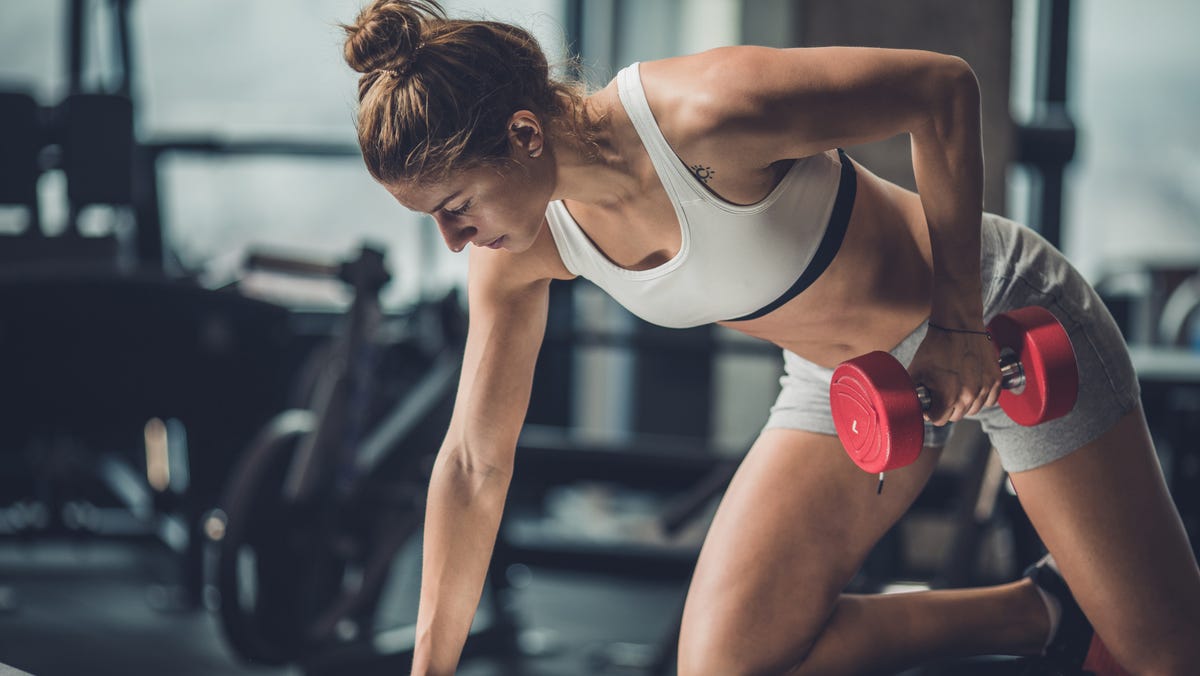
- Dumbbell row: 3 x 10-12
- Incline dumbbell curl: 3 x 10-12
- Overhead triceps extension: 3 x 10-12
Day 2: Lower body and core
Day 3: Rest or light cardio
Day 4: Upper body
- Chin-up or lat pulldown: 3 x 6-10
- Push-up or close-grip push-up: 3 x 8-15
- Hammer curl: 3 x 10-12
- Triceps pushdown or bench dip: 3 x 12-15
- Lateral raise: 2 x 12-15
Days 5 to 7: Lower body, walking, and rest
Common arm workout mistakes
- Swinging the weight. Momentum cheats the muscle.
Go lighter and slow down.
- Training only arms. Rows, presses, and pull-ups do much of the work.
- Skipping the lowering phase. Controlled lowering is half the exercise.
- Never increasing the load. If every set feels easy, go heavier.
- Under-eating.
Building muscle takes fuel, and extreme dieting works against it.
FAQs
How often should women train biceps?
Twice a week is plenty for most people, with at least 48 hours between sessions. Rows and pull-ups also work the biceps, so they count toward your total.
Will lifting make women bulky?
Unlikely. Women tend to carry less lean tissue in the upper body, so developing bodybuilder-style arms by accident isn’t a realistic concern. Visible muscle takes months of consistent, progressive training and enough food.
How long does it take to see results?
Strength usually improves within a few weeks.
Visible changes often take a few months, depending on your starting point, training, diet, and genetics.
What weight should I start with?
Pick a weight you can lift for 10 to 12 controlled reps with the last 2 feeling difficult. Typically that means light dumbbells for beginners, then gradual increases.
Can I build arms without weights?
Yes. Push-ups, dips, planks, and resistance bands can build strength, especially if you progress the difficulty over time.
Can I get toned arms by spot-reducing fat?
No. You can’t choose where your body loses fat.
Strength training builds the muscle underneath, and overall body fat determines how visible it is.
Start light, learn the movements, add weight gradually, and give it a few months. Visible change takes patience, but strength shows up much sooner, and it’s the part that lasts.
If you have joint pain, an injury, or a health condition, check with a doctor or qualified trainer before starting a new program.
Sources
Disclaimer
The Content is not intended to be a substitute for professional medical advice, diagnosis, or treatment. Always seek the advice of your physician or other qualified health provider with any questions you may have regarding a medical condition.
Disclaimer: This story is auto-aggregated by a computer program and has not been created or edited by jennertrends.
Publisher: Source link