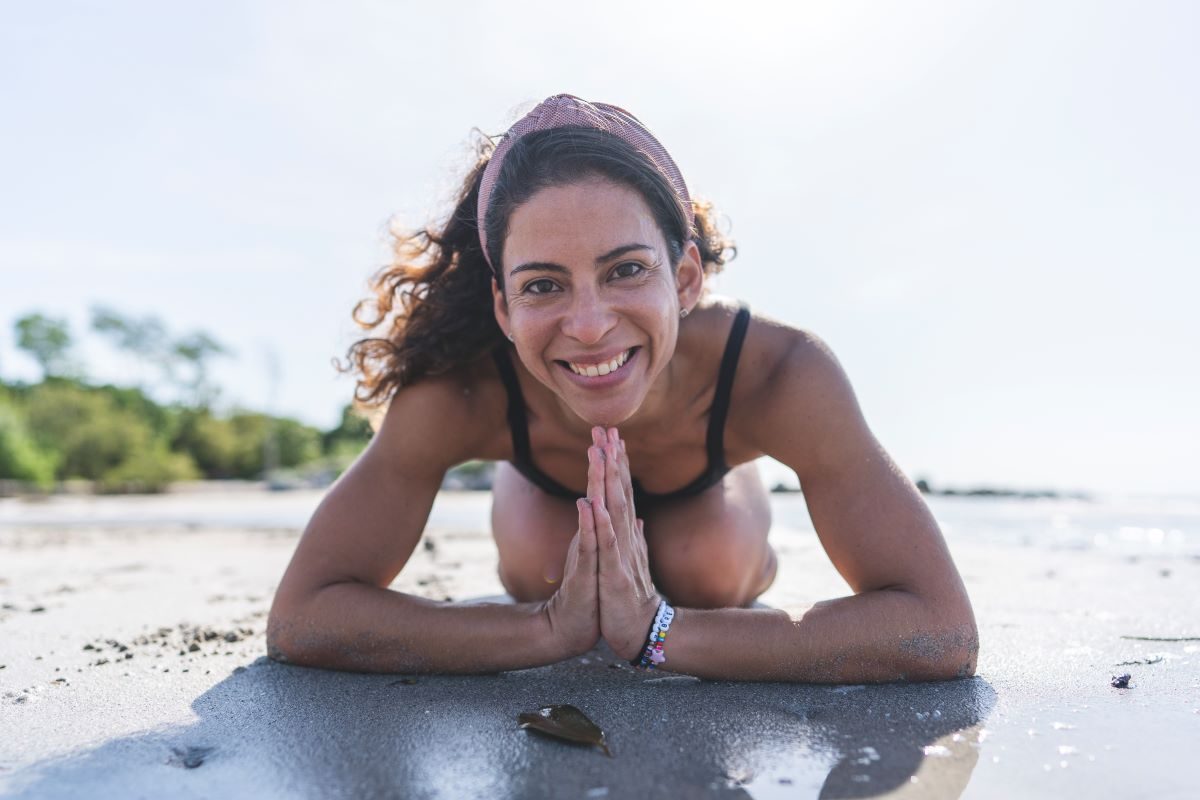
Claudia “Pia” López is a yoga teacher and the founder of Pia Yoga, known for her alignment-focused classes. With a background in economics, international business, and six years in marketing, she discovered yoga as a way to calm her mind.
What began as a search for calm became a calling in 2013, when a power yoga class deepened her commitment to the practice. Since then, she has trained with some of the most respected names in yoga, including Kino MacGregor, David Keil, Gokulacandra, Gurmukh, and Anand and Sadhana, the creators of Skanda Yoga.
She is now an E-RYT 200 and YACEP® with 500+ hours of training.
In her Women Fitness interview, Pia shares yoga alignment tips, a routine for desk workers, and her views on the future of teacher training.
The Detail Everyone Misses
Your teaching is built on the idea that tiny alignment adjustments change everything. What is the one detail you see students miss most often, and how does fixing it transform their practice?
My motto is that small alignment details make a big difference, and the one I see missed most often is hand placement.
Many poses ask us to bear weight on the hands, such as Downward Dog, Plank, and Chaturanga. If the hands are not set up well, the rest of the pose cannot hold, and the wrists end up taking the load. That is where much of the wrist discomfort practitioners complain about begins.
Two cues change a lot.
- First, root the four corners of the palm into the mat, especially the base of the index finger knuckle.
- Second, make your grip firm: press the fingers down as if you were gripping the mat, so firmly that someone else could not lift a single finger even if they tried.
When students do this, the pose becomes more stable, and the weight spreads across the whole hand instead of collapsing into the wrist. They feel the difference quickly, and that is when real progress begins.
From Hobby to Necessity
Yoga used to be seen as a hobby or a fitness option.
When did you notice it shifting into something people need, like sleep, food, and movement?
I came to yoga looking for a tool to calm my mind and feel connected, so I have always seen it as something deeper than exercise. But I believe many people entered the practice for other reasons: the trend of “cool” poses like arm balances, or simply because it helped them stretch.
Those who kept going and added tools beyond the physical side, like meditation and breathing exercises, began to experience the deeper benefits. The pandemic accelerated this. With everyone at home and under a lot of stress, more people turned to these practices and saw the value of making them a habit, for a better quality of life that is not only physical but also mental and emotional.
Since then, I believe there has been a lasting rise in the value people place on wellness, and more people become interested every day.
Some stay with the physical practice, and that is perfectly fine. Everyone goes as deep as they want to.
A Routine for the Desk-Bound
Long hours at screens mean tight hips, rounded shoulders, and tech neck. What does an alignment-first routine look like for someone who sits eight to ten hours a day?
For someone who sits that long, I would not focus only on stretching, which is what many people think they need. I would focus on waking the body up and strengthening it as well.
Here is how I would build the sequence:
- Start standing. Simple movements like heel raises bring mobility and activate the legs.
- Open the upper body. Rounds of cactus arms, opening the chest forward and bringing the arms back up, counter the rounded back of desk work and activate the upper back.
- Move the spine. Cat-cow activates the back and abdomen.
- Build leg strength. Chair pose, warriors, and high lunges wake up the legs and psoas, and adding pulses builds even more strength.
- Add hip mobility. Malasana, pigeon, and bound angle pose, plus twisted variations of each, followed by leg stretches such as a seated forward fold or any supine variation.
- Work the core. Boat pose is a good choice.
- Wind down. Bridge pose and a final twist, then a final relaxation that helps the body fully release, and the student disconnect from the working day.
Foundations First
Many students rush toward advanced poses before their foundations are ready. How do you help them advance safely, and what does real progress look like beyond a deeper bend or a harder pose?
We tend to want results right away without building the foundation first, and that is often when injuries happen. I put a lot of emphasis on helping my students develop the strength they need, through different exercises and drills, before trying to go further.
Think of a tennis player. They do not train only by hitting the ball with a racket.
They also lift weights to build strong muscles and do mobility work to hit better. I take the same approach in my classes. When we finally try the pose we are working toward, it comes much more easily, because we have already prepared the ground.
Take my Crow Pose workshop.
- First, we study the biomechanics of the pose and how each part of the body works in it, because sometimes the mind needs to prepare too.
- Then we do exercises to strengthen the grip, arms, abdomen, and psoas, the muscles that must be active for the pose.
- Finally, since every body is different, I show a variety of ways to enter the pose, so each student can find the version that works for them.
This not only makes the pose easier. Students build real strength, and along the way they develop discipline, consistency, and patience.
For me, that is real progress: not a deeper bend or a harder pose, but a stronger, more prepared practitioner.
Yoga for the Nervous System
With constant notifications, burnout, and digital fatigue, how is yoga becoming a daily tool for mental health, focus, and nervous system regulation, and not just a physical practice?
A true yoga practice goes beyond the physical side and the poses. It includes tools like meditation and breathing exercises, which help us regulate our nervous system and connect with our inner wisdom. They help us become more centered, get to know ourselves better, recognize when we need to pause, and know how to do it. The poses themselves are also designed to move our energy and stimulate different aspects of ourselves, sometimes to activate and sometimes to relax.
This matters because people who are so busy, surrounded by so much noise and external stimulation, can step into a practice and find a sacred space to disconnect from daily life and recharge.
That is why they leave feeling the calm and peace they really needed.
And the more they practice, the more these tools become part of them, so they can use them in daily life whenever they need them.
Teachers and Technology
Apps, videos, and AI-driven coaching are growing fast. What can a human teacher see and correct that technology cannot, and how do you see teachers and tech working together?
A teacher can see the real energy of a person, how they are doing and what they need, whether they are in the room or on the other side of the camera. AI can give general cues, but only the teacher may know the person’s past, their history, and how that specific student needs to modify a pose for their body.
Beyond that, the human relationship with the student cannot be replaced. Knowledge has always been available, and now there is even more of it, but relationships are what make it matter.
People want a relationship with someone real, someone who knows their story. The personality of the teacher is also what students connect with.
I see teachers and technology working together. Technology helps us deepen our own knowledge and learn much faster. It also supports the business side of our work, helping with many marketing tasks that were difficult before, so our work becomes more visible, and more people get to know us.
By 2027
By 2027, who do you expect to see on the mat that we don’t see enough today, and how should teaching adapt to them?
I think teenagers.
The earlier people start building these habits, the more prepared they are to deal with everything life throws at us, such as work stress and difficult situations. And the more aware and connected we are with our bodies, the more connected we are with ourselves and our inner wisdom.
I think we should look for practices they enjoy: active ones, with “cool” poses. If these catch the attention of adults, they will catch teenagers’ attention even more. It does not matter if they arrive for that reason.
If the practice is true, they will find their space for meditation, relaxation, and presence, and they will receive the benefits. Above all, they are building habits they can come back to whenever they need them.
The Minimum Effective Practice
Most people believe yoga needs an hour and a perfect studio. What is the minimum effective daily practice you recommend, and how can someone make it last?
A daily practice of presence, introspection, and conscious breathing, even if it is only 10 minutes, can make a big difference.
As for the physical practice, an hour a day would be ideal, but many of us also have other physical activities, such as running or lifting weights, and cannot fit in a practice that long. Many mothers find it hard to carve out that much time (I have lived this myself), and so do people with demanding jobs.
So if you can only move your body for 10 minutes, do it. If you have 20 to 30 minutes, do that. If you have more, make it longer. That is why I offer classes of different lengths on my YouTube channel.
The most important thing is consistency over the long term.
To make it a habit:
- Schedule it. Put your practice in your calendar. That is key.
- Make it easy. Keep your mat and clothes ready. You do not need much space, just a small corner where your mat fits.
- Find your people. Join a group, like the one my students have in my online studio, or a challenge like the ones I run on my YouTube channel.
- Make progress visible. My challenges come with a printable calendar where you check a box after each class. A visual record of something completed keeps the motivation going.
Yoga as Preventive Care
Healthcare is moving toward prevention: posture, mobility, stress, and longevity.
How does consistent, well-aligned yoga act as preventive care, and what changes do you see in students over months and years?
Many problems and injuries come from people sitting all day and then getting hurt by even a small movement, because their bodies are so tight or rigid. In the same way, some people start a new activity without the mobility or body awareness it requires, and get injured easily. A constant yoga practice helps us stay mobile, build strength, and keep our joints moving. It also supports mental clarity, helps us manage stress, and gives us a happier life, which leads to a better quality of life, with probably fewer illnesses and injuries.
Students who are runners or play other sports have told me that after adding a yoga practice, especially one focused on alignment, they have been able to do their other activities with almost no injuries.
I also have students of all ages, including a couple in their 70s who started to see real progress in every way after just a couple of months. They even told me it helped their skiing. Some students who lived with back or knee pain for months became pain-free after a few months of practice.
I am not saying yoga is the cure for everything, or that nothing more is needed in some cases. But the simple act of being more active, working on strength, mobility, and stretching, and becoming more conscious of our own bodies, including our need to rest or when to stop, can definitely help improve health.
What We Should Protect
If yoga becomes part of everyone’s daily life by 2027, what do you hope it looks like, and what do you hope we avoid, such as over-commercialisation, ego-driven poses, or injury-prone practice?
I do not think everyone should do yoga.
It is a very powerful tool, but there are other tools and practices that offer great benefits too. What I do believe is that everyone would benefit from a few minutes a day of meditation and/or breathing exercises that help us look inward, along with conscious movement that lets us explore ourselves while gaining mobility and strength.
What I would like us to avoid is people becoming yoga teachers in just a few days. Unfortunately, in many cases, yoga teacher trainings have become the only way studios and many teachers make a real profit, and I feel many of those trainings miss the depth this practice requires. Everything starts there.
More teachers go out to teach without enough knowledge, especially since there are often no requirements for previous practice, and in 20 to 30 days it is not possible to absorb, or even learn, such a deep philosophy and practice. If teachers do not take the practice seriously, we cannot transmit its depth.
Disclaimer
The Content is not intended to be a substitute for professional medical advice, diagnosis, or treatment. Always seek the advice of your physician or other qualified health provider with any questions you may have regarding a medical condition.
Disclaimer: This story is auto-aggregated by a computer program and has not been created or edited by jennertrends.
Publisher: Source link